
 中文
 عربي
 Français
 Nederlands
 Deutsch
 Italiano
 Português
 Español
Yes, African safari safety is very good when you travel with a licensed operator, a trained guide and a few sensible habits. Most safari injuries trace back to a short list of avoidable mistakes: leaving the vehicle, crowding an animal, walking alone after dark, skipping malaria prevention, or leaving valuables in sight. Seven rules cover almost all of the risk. First-timers should start with rules 1 and 2, families should read rules 4 and 5 closely, and anyone planning a self-drive should read rules 2, 3 and 7.
Most travelers search this topic because two pictures clash in their head. One is a lion beside the vehicle, and the other is a brochure that never mentions risk. Neither helps you decide. Wildlife is wild, so the risk is real. It is also small, and it sits in predictable places. Once you know those places, you can stop worrying and start enjoying the trip.
We are Extra Miles Unique Adventures, a Nairobi-based tour operator that has run private safaris across Kenya, Tanzania, Uganda and Rwanda since 2007. The rules below follow the order of a trip, from what you decide before booking to what you do each day in the bush. You will also find an animal risk table, a health checklist and a country comparison to help you choose where to go.
1. Book a licensed local operator and a trained guide
The most important safety decision is who you book with, because the operator chooses your guide, your vehicle and your camps. A licensed local operator with trained guides lowers nearly every other risk on this list, which is why African safari safety starts at the booking stage.
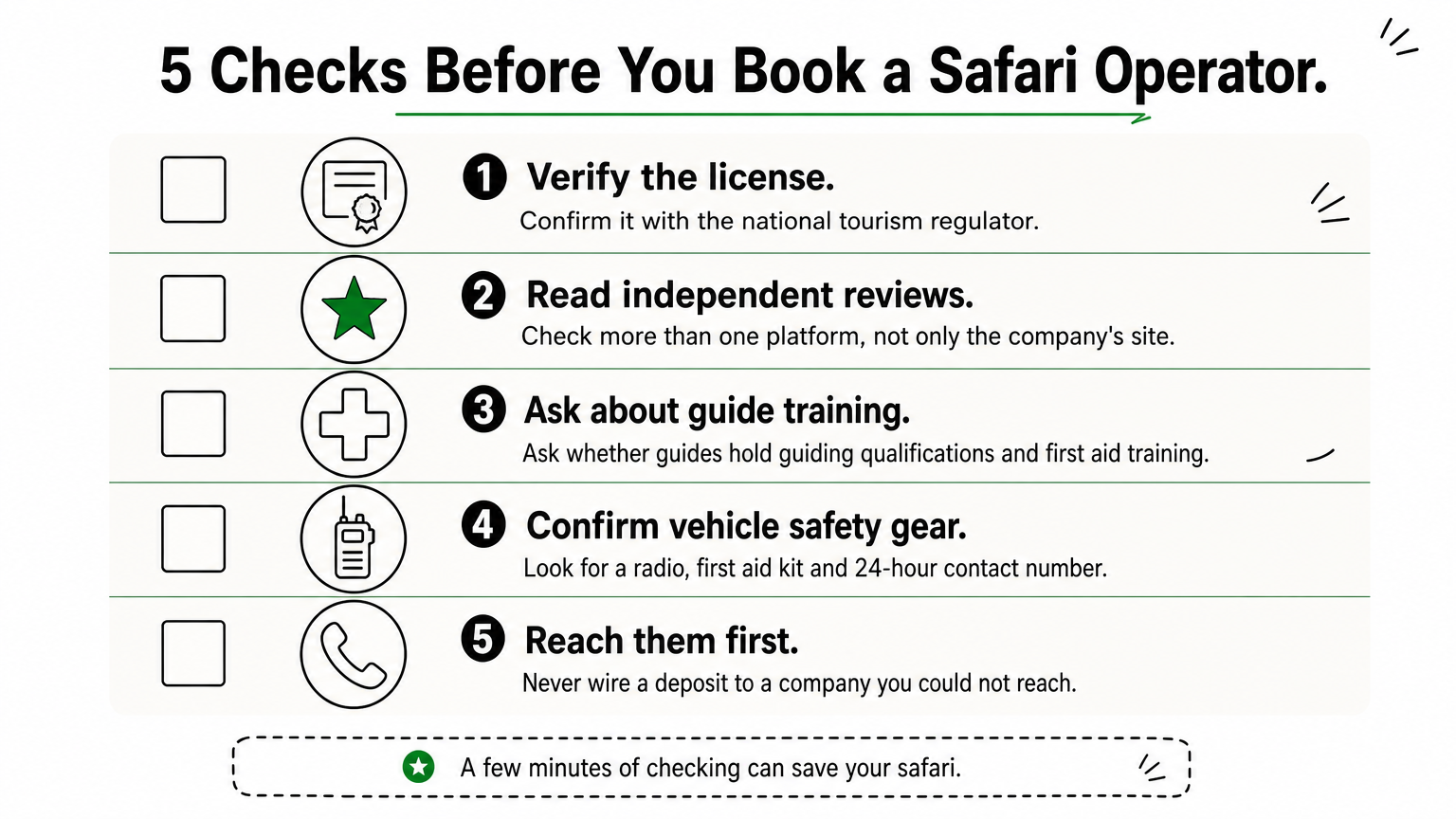
Your guide is your safety system, so choose the company before you choose the lodge.
How to apply it
Start by checking that the company holds a valid license from the tourism regulator of the country where it operates. It should also publish a physical address and a phone number that someone answers. Then ask who your guide will be, how that guide was trained, and what the plan is if someone gets hurt.
- Ask for the operator's license details and verify them with the national tourism regulator.
- Read independent reviews on more than one platform, not only the company's own site.
- Ask whether guides hold professional guiding qualifications and first aid training.
- Confirm that the vehicle carries a radio and a first aid kit, and that you get a 24-hour contact number.
- Never wire a deposit to a company you could not reach by phone or WhatsApp.
Private versus shared matters too. On a private safari, the guide answers only to your group, so the pace and the rules are yours to set. In a shared vehicle, such as a budget Masai Mara group safari, you share one vehicle and one guide with other travelers. That arrangement works well when the guide sets the rules and everyone follows them.
What goes wrong without it
Unlicensed operators cut corners where you cannot see them. You may get an overloaded vehicle, a driver with no wildlife training who edges closer for a better photo, no emergency plan, or in the worst case no safari at all after you pay.
A trained guide does something you cannot do yourself. A good guide reads an elephant's posture, notices a buffalo that is stressed, and reverses before an animal commits to a charge. We plan each trip with partners for accommodation, transport and activities that are chosen for comfort, safety and value, and we reply to enquiries within 24 hours. That gives you time to ask every question above before you pay anything.
2. Stay in the vehicle and follow the guide's lead
On a game drive, stay seated inside the vehicle, keep your arms and legs inside, and step out only when your guide says it is safe. Animals treat a safari vehicle as one large, harmless shape, and breaking that shape is how people get into trouble.
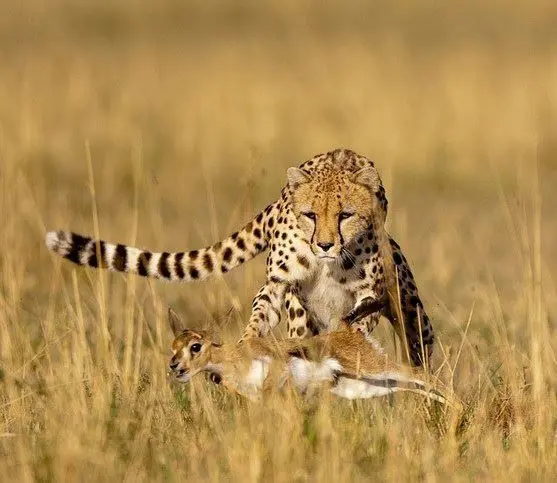
The vehicle is your protection, so never leave it, lean out of it or stand up in it without the guide's say-so.
How to apply it
Treat the morning briefing as binding. On our private Kenya itineraries, such as the 4 Days Masai Mara and Lake Nakuru Safari, you travel in a pop-up roof Land Cruiser. The roof lets you stand and photograph while the vehicle is stopped. Stand only when your guide says so, and sit down when the engine starts.
- Keep your voice low and your movements slow near animals.
- Never feed animals, throw trash, or hang a limb out of a window.
- Do not ask the guide to go closer. Ask for a different angle instead.
- Wear neutral colors such as khaki, olive and tan. White gets dirty fast, while dark blue and black attract tsetse flies. Leave camouflage at home, because civilians cannot wear it in several African countries, including Kenya and Tanzania.
- Fasten your seat belt wherever the vehicle has one.
What goes wrong without it
Have lions ever attacked safari vehicles? Rarely. The cases that reach the news usually involve a person standing in an open window, leaning out, or getting out. Elephants have charged vehicles that crowded a herd or blocked an escape path. Both situations are the guide's call to avoid, and both get worse when a guest pushes for a closer view.
Self-driving adds more risk. You need a high-clearance vehicle, the skill to handle mud, and the judgment to read animals without a guide beside you. If you self-drive, pick a smaller park with marked roads, stay on the tracks, carry a charged phone and an offline map, and keep a wide gap from large animals. For a first safari, hire a guide.
3. Respect distance and learn which animals are riskiest
Keep the distance your guide sets, and remember that the animals to worry about are often not the ones you expect. Hippos, buffalo and elephants have a worse reputation for human injuries than lions, which mostly ignore vehicles. A realistic view of safari wildlife danger shows that surprise and crowding cause most trouble, not hunting.
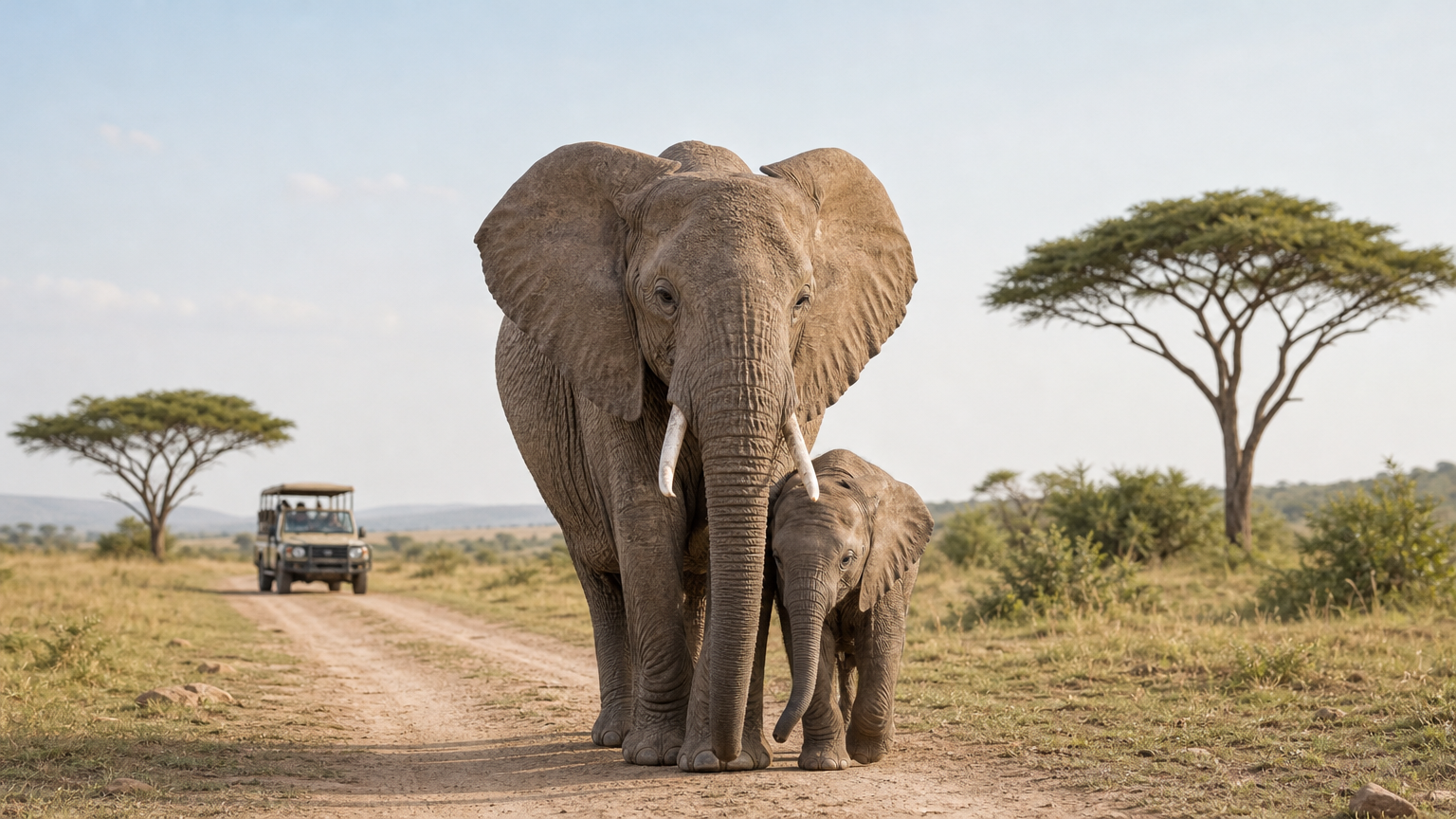
Danger on safari comes from surprise and crowding, not from animals hunting tourists.
How to apply it
Learn the warning signs before you need them. Flattened ears, head shaking, mock charges, a raised trunk and a fixed stare all mean the animal wants space. Your guide will back off at the first sign. This table covers the animals you are most likely to meet.
| Animal | Why it is risky | What to do |
|---|---|---|
| Hippo | Territorial and aggressive, and it leaves the water to graze at night | Stay back from water edges and never stand between a hippo and the water |
| Cape buffalo | Unpredictable, especially lone bulls and herds with calves | Keep vehicle distance and never approach on foot |
| Elephant | Mothers with calves and bulls in musth can charge | Give space and never block an elephant's path |
| Lion and leopard | Ignore vehicles but see a person on foot as prey | Stay seated and get out only after your guide clears the area |
| Crocodile | Ambushes from riverbanks | Keep back from banks and never swim or wade unless a guide has cleared it |
What goes wrong without it
Trouble usually starts at busy sightings, when several vehicles crowd one animal and everyone wants a photo. If your guide says it is time to leave, leave. A cheetah on a termite mound is not worth a stressed elephant behind you.
Small things matter too. Baboons and vervet monkeys steal food from open windows and tents, so keep snacks sealed. In camp or on a bush break, shake out your shoes before putting them on, because snakes and scorpions like dark, warm places. Never touch or feed any animal, however cute it looks.
4. Follow the camp rules after dark
After dark, never walk alone between your tent and the dining area, because wildlife moves through camps at night. Camps are safe when you follow their escort rules, whether they are fenced or unfenced.
Call for the escort every night, even for a short walk.
How to apply it
Ask at check-in whether the camp is fenced or unfenced, how to call for an escort, and where the emergency contact is. Unfenced camps put you close to wildlife, and staff walk you to your tent after dinner. Fenced camps keep large animals out, but they do not keep out monkeys, snakes or insects.
- Zip tent flaps fully and keep food out of tents.
- Use the flashlight, whistle or radio the camp provides.
- Stay on marked paths, and do not follow a noise with your flashlight.
- Check shoes and bedding in tented camps.
- Close balcony doors in rooms that face the bush, or baboons will visit.
- Keep children beside you at all times, and check each camp's age policy.
What goes wrong without it
Most camp incidents are minor. A baboon raids an open room, a snake sits in a shoe, or an elephant stands on the path to dinner. The serious cases happen when a guest walks out alone to see what made a noise. Riverside camps are the clearest example, since hippos often graze on the grounds at night.
Treat the escort rule as non-negotiable, even if you feel silly calling for help. The staff walk that path every night and know where the animals are. Families should also check age limits, because some camps and walking safaris set minimum ages for children.
5. Prepare for malaria and other health risks
Malaria is the biggest health risk on most African safaris, and prevention is simple. See a travel health provider before you go, take the medication prescribed for your route, and prevent bites every evening. Most safari areas in East Africa carry some malaria risk, so plan for it unless a doctor tells you otherwise.
The mosquito is a bigger threat than any lion, and it is the easiest one to stop.
How to apply it
Book a travel clinic visit ideally four to six weeks before departure, which is the CDC's general advice for international trips, so vaccines and prescriptions have time to work. The CDC also publishes health guidance for African safaris. Then build a daily routine.
- Ask about malaria medication, routine vaccines, typhoid and hepatitis A.
- Check yellow fever rules, because some countries ask for a certificate depending on where you travelled from.
- Use repellent with DEET or picaridin, and wear long sleeves and trousers at dusk and dawn.
- Sleep under a net or in a screened room.
- Drink bottled or filtered water, which most lodges provide.
- Keep prescription medication in your carry-on, with copies of the prescriptions.
- Buy travel insurance that covers medical care and emergency evacuation.
What goes wrong without it
Malaria symptoms can appear weeks after you get home. If you develop a fever after your trip, tell your doctor you visited Africa. Skipping the pills because you saw few mosquitoes is the classic mistake, since an infected bite looks like any other.
Insurance is the other expensive gap. Remote parks can be hours from a hospital, and an evacuation flight is costly without cover. Tsetse fly and tick bites are a nuisance rather than a danger for most visitors, but long sleeves and repellent handle those as well.
6. Protect yourself from petty crime and road risk
On safari itself, crime is rare. The real exposure is in cities, airports and on the road, where petty theft and traffic are the main risks. Treat arrival and departure days with the same care you give game drives.
Safari crime risk is a city risk, so take your precautions to the airport, not just the park.
How to apply it
Arrange a pre-booked transfer with a named driver instead of accepting offers in the arrivals hall. Keep your phone, camera and passport out of sight in busy areas, and plan your valuables before you leave the room.
- Lock passports, spare cash and jewelry in the hotel safe.
- Carry a photo or photocopy of your passport instead of the original.
- Take only the cash you need for the day.
- Avoid walking in city streets after dark and use hotel-arranged taxis.
- Keep bags out of view in vehicles, and never leave them unattended in a lobby.
- Put valuables, medication and a change of clothes in your carry-on.
What goes wrong without it
Thieves target what they can see and who looks distracted. A phone on a café table or a camera bag on a vehicle seat while you shop is the usual story. These losses spoil a trip without threatening you, and a few habits prevent almost all of them.
Roads deserve more respect than most travelers give them. The CDC lists road crashes among the leading causes of injury for travelers, and the roads between parks can be rough and fast. Avoid driving at night and wear your seat belt. Scheduled flights between parks cut long road days, which is the idea behind our 6-Day Amboseli to Masai Mara Luxury Fly-In Safari.
7. Choose a lower-risk country and check advisories
Botswana, Namibia, Rwanda, Kenya, Tanzania, Uganda and Zambia all run well-established safari industries and receive large numbers of visitors each year. No country is risk free, so read your government's travel advisory before booking and again before you fly. U.S. travelers can find theirs at travel.state.gov.
Safe safari trips share one trait: the itinerary stays inside well-run parks and avoids areas that advisories flag.
How to apply it
Rankings differ by source and year, so treat any single "safest" label with caution. Botswana, Namibia and Rwanda are the countries most often named among the calmest. Match the country to your trip and then check the specific region on your itinerary, not the national headline.
| Country | Known for | What to check |
|---|---|---|
| Botswana | Okavango Delta, Chobe, private concessions | Remote camps, so confirm medical evacuation cover |
| Namibia | Etosha, desert wildlife, self-drive routes | Long distances and desert driving conditions |
| Rwanda | Mountain gorilla trekking | Permits and strict park rules |
| Kenya | Masai Mara, Amboseli, Samburu, Great Migration | Advisories name specific areas near the Somali border, far from the main parks |
| Tanzania | Serengeti, Ngorongoro, Zanzibar | Malaria prevention and current entry rules |
| Uganda | Gorilla and primate trekking | Yellow fever rules and ranger-led treks |
| Zambia | South Luangwa walking safaris, Victoria Falls | Walk only with licensed guides |
South Africa's parks, including Kruger, are also safe for visitors, but its cities carry higher crime, so rule 6 matters more there.
What goes wrong without it
Booking on a rumor or a single headline is the usual error. Advisories often cover whole countries, while the issue they describe sits far from any park. Read the details, ask your operator which areas it avoids and why, and recheck the advisory shortly before departure.
Your own confidence matters as well. If you are nervous, start small with a guided short escape, such as our 3 Days Amboseli National Park Safari from $609 per person, which keeps you with a private guide throughout. Season also changes the risk, since wet-season roads and mosquito numbers both shift with the weather, so ask your operator when each park is easiest.
Travel prepared and enjoy the wild
African safari safety comes down to seven habits. Book a licensed operator, stay in the vehicle, keep your distance, respect the camp rules after dark, prevent malaria, guard your valuables in cities, and pick your country and region with care. Do those things and a safari is one of the safer adventure trips you can take.
The best way to apply all seven is to plan with someone who knows the parks, the guides and the season. If you want a private trip built around your dates, group size and comfort level, request a tailored safari quote and our team will answer your safety questions along with your itinerary.