
 中文
 عربي
 Français
 Nederlands
 Deutsch
 Italiano
 Português
 Español
The cheapest reliable way to book Tanzania safari tours on a budget is to pay a licensed local operator for a northern-circuit trip, travel outside July to October, and choose either a shared camping departure or a private trip with simple lodges. Expect roughly $250 to $370 per person per day with park fees included. A price far below that usually hides a cost somewhere else.
The trouble is that cheap Tanzania safari listings rarely compare cleanly. One quote includes park fees and another adds them later. One vehicle seats four guests and another squeezes in seven. Park fees and lodging are fixed costs, so a price that looks too good to be true usually means the operator cut something you care about, such as vehicle quality, guide experience or the fee line itself.
This guide walks you through seven steps, from setting a per-day budget to comparing quotes and paying safely. You get price tables, a worked total for a 7-day trip, a message you can copy and send to operators, and sample itineraries. Extra Miles Unique Adventures is a Kenya-based tour operator that has planned private safaris across Kenya and Tanzania since 2007, so the advice reflects how East African safaris are priced and put together.
What a budget Tanzania safari costs and includes
A budget Tanzania safari costs roughly $250 to $370 per person per day for a guided trip that covers park fees, lodging, meals and a driver-guide. Shared group camping sits at the low end, and private trips with simple lodges sit at the top. These are planning ranges, not quotes, and they move with season, group size and operator.
Typical prices per person per day
The table below sets the main styles side by side so you can see where a quote falls. Cheap safari tours in Tanzania almost always belong to the first two rows.
| Style | Typical price per person per day | What it usually means |
|---|---|---|
| Shared group camping | $200 to $270 | Fixed departure dates, camping, shared vehicle |
| Private budget | $300 to $370 | Private vehicle, basic lodges or tented camps, flexible dates |
| Private mid-range | $400 to $415 | En-suite lodges, better meals, often inside or beside the parks |
| Luxury | $600 and up | Large camps, prime locations, internal flights possible |
The gap between private budget and mid-range is often only about $45 a day. If your budget has any room, ask for both quotes before you decide. The upgrade in lodging and location can be worth more than the cost.
What the daily price usually includes
A legitimate budget quote should cover these items, and you should see each one in writing:
- Park and conservation fees for every day inside a park
- A 4x4 vehicle, normally a Land Cruiser with a pop-up roof, and a driver-guide
- Accommodation for every night, with the meal plan stated
- Drinking water on game drives
- Airport transfers at the start and end of the trip
Accommodation and park fees together often make up more than half the price of a mid-range safari. That is why operators cannot discount much without trimming something visible.
What the price leaves out
Most quotes exclude the items below, so add them to your own total:
- International flights
- Tanzania visa
- Tips for your guide and camp crew
- Travel insurance
- Drinks beyond water and any personal spending
- Optional extras, such as a hot-air balloon ride (commonly around $600 per person) or an internal flight (around $300 per person one way)
- Zanzibar hotel nights and flights, if you add a beach finish
Why very low prices are a warning sign
A private Tanzania safari that visits the Serengeti and Ngorongoro Crater for far less than about $250 a day should make you stop and ask questions. Park fees and lodging cost the operator the same no matter how low the price goes. The saving has to come from somewhere, and it is usually park fees billed later, an overloaded vehicle, an inexperienced guide, or a company that will not exist next season.
Cheap does not mean suspect. A fair price is low because the operator owns its transport, uses simple lodges or camping, and keeps a thin margin. A suspicious price is low and vague at the same time, so the rest of this guide shows you how to tell them apart.
A fair budget price pays for parks, beds and a vehicle, and anything far below that drops something you will need.
Step 1. Set a per-day budget and a total
Multiply the daily rate you can afford by the number of days, then add flights, visa, tips and insurance to reach your real total. Setting the total first stops a low daily rate from hiding a trip you cannot afford once everything is added.
Work out your trip total
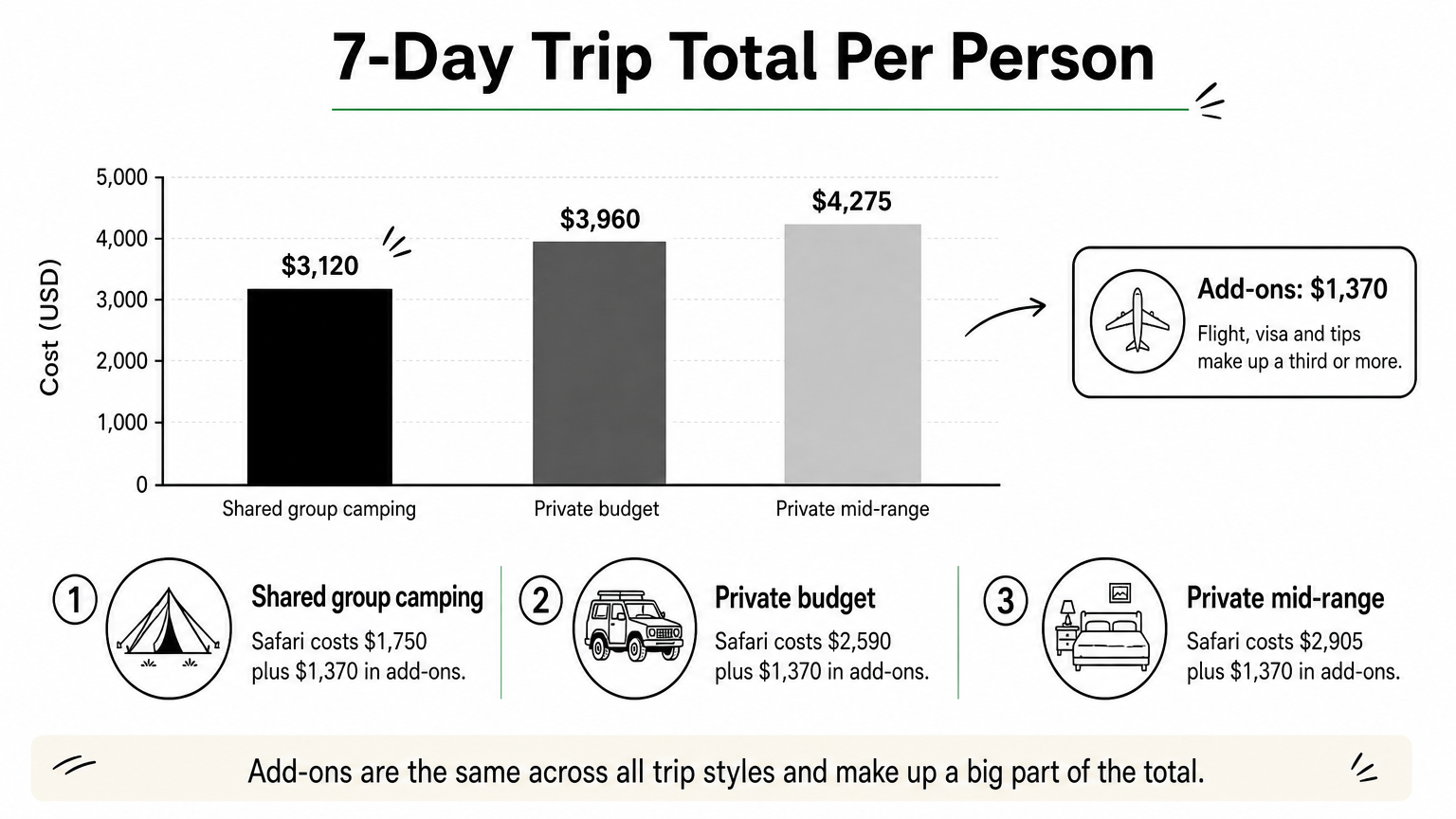
Here is a worked example for a 7-day trip, per person, using the planning rates from the table above. The add-ons are a $1,200 return flight from the US, which is a common figure and rises in peak season, a $100 visa for US citizens, and $70 in tips at $10 per person per day.
| Trip style | Safari at daily rate | Add-ons | Total per person |
|---|---|---|---|
| Shared group camping at $250 a day | $1,750 | $1,370 | $3,120 |
| Private budget at $370 a day | $2,590 | $1,370 | $3,960 |
| Private mid-range at $415 a day | $2,905 | $1,370 | $4,275 |
Add-ons of about $1,370 are a third or more of a budget trip. Tips at the higher end of the common range, $20 per person per day, add another $70 to each total. Travel insurance and malaria prevention come on top, so ask your doctor and insurer for current prices.
Count the costs outside the quote
Flights are the biggest outside cost, so check fares early and be flexible with dates. A visa costs $100 for US citizens and $50 for most other visitors. Tipping is expected in Tanzania, and a guideline of $10 per person per day for the guide and crew is what we suggest to our own guests. Some operators suggest more for the driver-guide alone, so ask what yours expects.
Decide what to trade for the price
Every budget forces one trade, so pick yours on purpose:
- Fewer days at a higher comfort level, such as 5 days in good lodges instead of 8 in basic ones
- More days at a lower comfort level, such as camping across a longer route
- Fewer parks, so that more of the price goes into time with the animals rather than driving
Pick the trade that matches why you are going. If you want the Serengeti and the Ngorongoro Crater and do not mind simple beds, buy basic lodging and keep the route. If you want a good bed after long drives, buy fewer days.
Budget the whole trip, not the daily rate, because add-ons can reach a third of what you spend.
Step 2. Choose a group or private format
Pick a shared group safari if you travel solo, want the lowest daily price and can live with fixed dates. Pick a private trip if there are two or more of you, or you want control over timing and pace. This choice moves your price more than any other.
Group and private safaris side by side
| Shared group safari | Private safari | |
|---|---|---|
| Daily price | Lowest, roughly $200 to $270 | Higher, roughly $300 to $370 at budget level |
| Dates | Fixed departures | Your own dates |
| Itinerary | Set routes, often 3 or 6 days | Built around you |
| Lodging | Usually basic camping | Basic lodges or tented camps |
| Vehicle | Shared with strangers | Yours alone |
| Best for | Solo travelers, tight budgets | Couples, families, small groups |
Group departures save the most for solo travelers. The savings are smaller if you compare like-for-like lodging, because a shared trip often uses camping while a private trip uses lodges. Compare the same accommodation level before you decide the group format is cheaper.
How group size changes the price
The vehicle and the guide cost the same whether one person or four ride in the truck. A private budget safari therefore gets cheaper per head as the group grows, and a solo traveler pays the whole fixed cost alone. This is why we ask for your group size before we quote, and why our final prices depend on dates, group size and accommodation tier.
If you are traveling solo, ask any operator whether they can place you on a shared vehicle on specific dates. A solo traveler joining a group departure can cut the price sharply compared with a private truck for one.
Why self-drive rarely saves money in Tanzania
Self-driving looks like the cheapest option, but in Tanzania it rarely is. Most northern parks are set up for guided safari vehicles, you must arrange fuel, permits and lodging yourself, and your first-time spotting skills will not match a trained guide.
You also save little when two or more people share a guide. The vehicle, fuel and park fees stay the same, and the guide's wage divided between a group is a small share of the total. You are likely to see far fewer animals alone.
Group departures save the most for solo travelers, while private trips cost less per head as the group grows.
Step 3. Keep the route north and time your trip
Stay in northern Tanzania and travel outside July to October to get the lowest prices on a Tanzania safari tour. The northern circuit connects Tarangire, Lake Manyara, the Ngorongoro Crater and the Serengeti by road, so you avoid costly internal flights.
Keep the route in northern Tanzania
The northern parks sit within a few hours' drive of Arusha and of each other, so a good 6- or 7-day trip needs no flights between them. The southern parks, such as Nyerere and Ruaha, are remote and usually require domestic flights, which push prices up.
A 7-day northern route could run from Arusha to Tarangire, then to Karatu for the Ngorongoro Crater, then on to the Serengeti, and back by road. It covers elephants, big cats and the crater floor without a single internal flight.
Time your trip for lower prices
Prices follow demand, and demand follows the weather and the migration. Use this table as a rough guide and ask each operator for quotes for specific dates.
| Period | Conditions | Price effect |
|---|---|---|
| July to October | Dry season, peak wildlife viewing, migration in the north | Highest rates, book early |
| Christmas and New Year | School holidays | High rates |
| January to February | Calving season in the southern Serengeti | Moderate to high, ask for quotes |
| March to May | Long rains, heaviest in April and May | Lowest rates, some camps close |
| June and November | Shoulder months | Usually below peak |
The cheapest months come with muddier roads and a few closed camps. Wildlife is still excellent, the parks are quieter and your guide will have more time for you. If you can travel in the shoulder months, you often get most of the dry-season experience for less.
Handle the Ngorongoro Crater with care
Budget lodging for the crater is usually in Karatu, a town 1.5 to 2 hours' drive from the rim. You wake earlier, enter the crater later in the morning and miss some of the best big-cat time. Lodging on the crater rim lets you enter at about 6 a.m. but costs more.
If lions matter most, spend the extra for a rim stay for one night and save elsewhere. If you simply want to see the crater, Karatu is fine and the savings are real.
Stay in the north by road and travel outside July to October, and you remove the two biggest avoidable costs.
Step 4. Pick simple lodging and cut the extras
Choose camping or basic lodges for the nights, and cut optional extras rather than the essentials of a good safari. Lodging is the largest line in your price after park fees, so it is where you save the most.
Choose basic lodges or camping
Camping typically costs about half as much as a lodge-based safari. Basic tented camps and budget lodges save the next most. They are plain: smaller rooms, simpler food, and sometimes bucket showers or a shared bathroom, though flush toilets and running water are normal.
Budget lodges are also often outside the prime wildlife zones. In the Serengeti, budget lodging is usually inside the park because the distances are too great to drive in and out. Ask where each night's lodging sits, because a cheap bed an hour from the gate costs you game-drive time.
Cut the extras, not the essentials
Some savings are smart and others cost you the safari. Use this table to decide.
| Cut this | Keep this |
|---|---|
| Hot-air balloon ride (about $600 per person) | Park fees included in the quote |
| Internal flights | A 4x4 with a pop-up roof and a window seat for each guest |
| Cultural visits you do not want | An experienced driver-guide |
| Beach or Zanzibar extension | Travel insurance |
| Extra parks that add long drives | Enough days to see the main parks without rushing |
Fewer parks usually means more wildlife time, because every extra park adds drive hours and fees. A 6-day trip with three parks beats a 6-day trip with five.
Shorten the trip before you cheapen it
If the total is still too high, cut a day or two instead of dropping to unsafe or dull options. A shorter trip with a good guide and a reliable vehicle will give you better sightings than a longer one on a worn truck.
Cut the balloon, the flights and the extra parks, but never the park fees, the vehicle or the guide.
Step 5. Book through a local operator
Book directly with a licensed Tanzanian or East African operator, not an overseas agent, to avoid a markup that commonly runs from 30% to 170%. The overseas agent usually hands your trip to a local company anyway, so you pay for the same safari twice.
Why local operators cost less
A local operator runs the vehicles, hires the guides and negotiates lodge rates directly, with fewer layers between you and the safari. Many own their own lodges or camps, which lets them keep prices low and quality steady. A foreign middleman adds office costs and profit on top of the local company's price.
Direct booking removes one layer of margin. Overseas agents do add real value for complex trips, such as flights bundled in one package, and some protections apply by country. For a budget safari, the local route is usually cheaper and just as good.
Local company or independent guide?
You can also book directly with a freelance guide, and it can be very cheap. The trade is risk and effort. Here is how the two compare.
- Local company: Fixed office, license, a team to answer messages, backup vehicles and guides if something breaks. Prices are slightly higher.
- Independent guide: Lowest price and a personal relationship. You rely on one person, replies can be slow when he is out on safari, and you must verify his license and vehicle yourself.
For most first-time travelers, a small local company is the safer budget choice. You get a license, a team and a backup vehicle without paying an overseas markup.
A licensed local operator gives you the same safari as an overseas agent without paying a markup.
Step 6. Vet a cheap operator before you pay
Vet any cheap operator by checking its license, recent reviews on several sites, and a written itemized quote before you send a deposit. Fifteen minutes of checks protects a trip that costs thousands of dollars.
Check the basics before you ask for a quote
Run through this checklist for every operator you consider:
- License: Ask for the Tanzanian tour operator license number, and check that it is current. Membership in an industry body such as the Tanzania Association of Tour Operators is a good extra sign.
- Reviews: Look for recent reviews on several independent platforms, not only the operator's own site. For example, Extra Miles holds a 5.0 rating from verified guests on Google and is listed on Safaribookings.com.
- Real people: Named guides and consultants, a reachable phone number or WhatsApp, and replies within a day or so.
- Specific answers: Vague replies to specific questions are a bad sign.
- No pressure: Be wary of a company that demands full payment up front, because paying most of the balance on arrival is more usual in Tanzania.
The cheapest and the biggest companies are rarely the best. Large operators can be stretched thin and tiny, very cheap ones may not last the season, so look for a middle: a small firm with a clear record.
Ask the right questions
Send the same message to each operator and compare the answers. You can copy and paste this one.
Subject: Quote request, 7-day northern Tanzania budget safari, [month and year]

Hello,

We are [number] travelers from the US planning a [number]-day northern Tanzania safari in [month]. Please send an itemized quote that confirms:

1. Total price per person, with park and conservation fees listed and marked included or excluded
2. Vehicle type, number of seats, and whether every guest has a window seat
3. Name and category of each lodge or camp, and the meal plan
4. Your driver-guide's languages and years of experience
5. Your Tanzanian tour operator license number
6. Deposit amount, balance due date, accepted payment methods and cancellation terms
7. What is not included, such as tips, drinks and optional activities

Thank you,
[Name]
Pay attention to how the operator answers, not only what it quotes. A clear, specific reply with a license number and named lodges tells you more than a polished brochure.
A license number, recent reviews and a specific written reply tell you more than a low price does.
Step 7. Compare quotes and pay safely
Compare at least three itemized quotes line by line, then pay a deposit by credit card and buy travel insurance before you travel. The cheapest total only wins when every quote includes the same things.
Compare quotes line by line
Put each quote's details into a table like this one. If an operator will not fill in a line, treat that as an answer.
| Line item | What to confirm |
|---|---|
| Park fees | Included for every day, not billed later |
| Vehicle | 4x4 pop-up roof, seats per vehicle, window seat guaranteed |
| Guide | Language, experience, whether the guide is full time |
| Lodging | Named lodges or camps, location, en-suite or shared bathroom |
| Meals | Which meals each day, and drinks |
| Transfers | Airport pickup and drop-off |
| Not included | Tips, flights, visa, optional activities |
| Terms | Deposit, balance date, cancellation rules |
Two quotes with a $200 gap often differ by exactly one line, usually park fees or the vehicle seat count. Fix the differences before you compare the totals.
Pay and protect your booking
Pay the deposit by credit card when you can, because card issuers generally give you stronger dispute rights than a bank or wire transfer, which is hard to reverse. Ask for the balance terms in writing, and be cautious about any request for the full amount months ahead.
Buy comprehensive travel insurance that covers trip cancellation and interruption, and check your own coverage before you pay. Confirm vaccine and malaria advice with your doctor or the CDC's travel health guidance well before you leave.
Compare itemized quotes on the same inclusions, because the cheapest total often leaves a line out.
Budget itineraries to use as a starting point
Three shapes cover most budget trips: a short 3 to 5 day northern loop, a 7-day northern Tanzania circuit, and a Kenya and Tanzania combination. The right one depends on your days, your budget and which parks matter most to you.
Short trips of 3 to 5 days
A short northern loop usually covers Tarangire, Lake Manyara and the Ngorongoro Crater, or adds the Serengeti with a camping format. Budget 4-day trips of this kind are commonly listed at around $1,400 to $1,800 per person, flights excluded.
These trips suit travelers with limited time. They are fast-paced with long drives, so choose them only if you accept less time per park. Five days is a better starting point if your budget allows it.
A 7-day northern Tanzania circuit
Seven days is the most popular length because it fits the highlights at a comfortable pace. A typical route runs Arusha, Tarangire, Karatu for the crater, then two nights in the Serengeti, and back to Arusha. At the private budget rate, it lands near the $2,590 total in Step 1.
Combining Kenya and Tanzania
If Tanzania is not a must, a Kenya-and-Tanzania trip can cut the per-day price. Our private trips below include park fees in the from-price, exclude international flights, and use a pop-up roof 4x4 Land Cruiser. The final quote depends on dates, group size and accommodation tier.
| Trip | Length | From price | About per day | Parks |
|---|---|---|---|---|
| 6-Day Kenya Big Five Express Safari | 6 days | $1,378 | $230 | Amboseli, Lake Nakuru, Masai Mara |
| 7-Day Epic Kenya & Tanzania Safari Experience | 7 days | $2,063 | $295 | Amboseli, Tarangire, Serengeti |
| 8-Day Magical Kenya & Tanzania Safari | 8 days | $2,711 | $339 | Amboseli, Ngorongoro, Serengeti, Masai Mara |
| 9-Day Ultimate Kenya and Tanzania Safari Experience | 9 days | $3,429 | $381 | Serengeti, Ngorongoro, Masai Mara, Lake Nakuru |
The 7-day trip runs about $295 a day from Nairobi to Arusha, which sits below the roughly $370 that a private budget safari in Tanzania alone commonly costs. The Kenya-only 6-day trip is cheaper still at about $230 a day. If Kenya works for you, shared Masai Mara departures of three days are published at roughly $380 to $620 per person, and a quote shows the current figure for your dates.
A Kenya and Tanzania combination can lower your per-day price, and a Kenya-only trip lowers it further.
Get a quote that lists everything
A budget Tanzania safari works when you set a total first, pick a group or private format on purpose, keep the route in the north, and travel outside peak months. Choose simple lodging, cut extras before essentials, and book with a licensed local operator that puts every inclusion in writing.
Send the same message to three operators, compare the answers line by line, and pay your deposit by credit card with insurance in place. If you want a Kenya and Tanzania route priced around your dates, group size and budget, request a tailored quote and our team will reply within 24 hours.