
 中文
 عربي
 Français
 Nederlands
 Deutsch
 Italiano
 Português
 Español
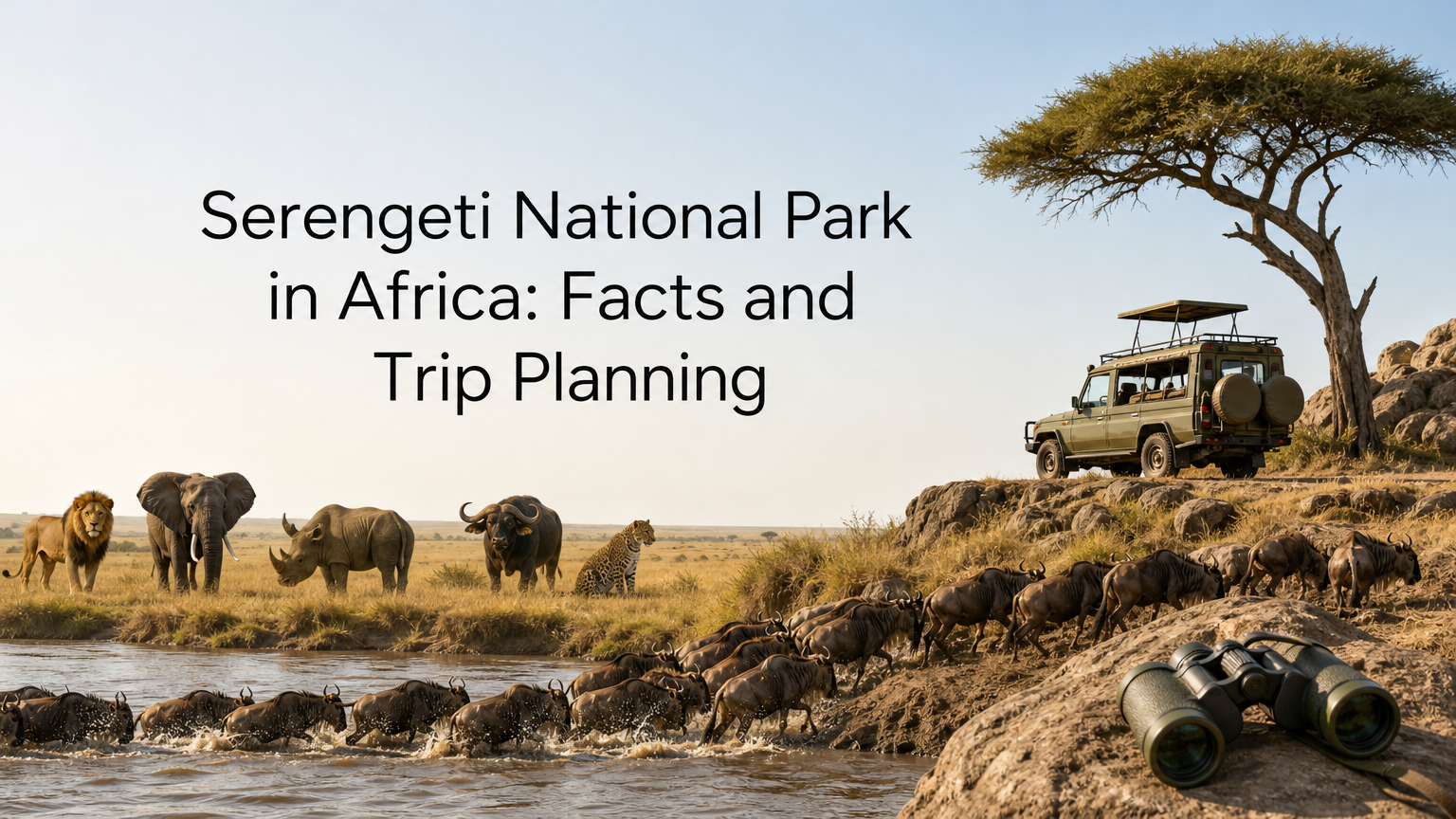
The Serengeti National Park in Africa is a protected area of about 14,763 square kilometers (5,700 square miles) in northern Tanzania, bordering Kenya's Maasai Mara. It is a UNESCO World Heritage Site, home to lions, leopards, cheetahs and elephants, and the main stage of the Great Migration, when around 1.5 million wildebeest, plus zebras and gazelles, follow the rains in a huge circle. Locals say the name comes from a Maasai word for "endless plains."
This guide goes beyond the definition. You will see why the park matters, where the herds are month by month, how to plan a safari there, and what it costs, including a worked park-fee example and priced packages.
We are Extra Miles Unique Adventures, a Nairobi-based tour operator that has designed private safaris since 2007. We often pair Kenya with Tanzania's northern circuit, so the advice below comes from planning these routes for travelers.
Why the Serengeti matters for a safari
The Serengeti matters because it combines huge scale, year-round wildlife and the Great Migration in one protected area. Few parks in Africa offer all three, and none offers them at this size.
Where it is and how big it is
The park sits in northern Tanzania and runs up to the Kenyan border, where it joins the Maasai Mara to form one continuous ecosystem. The Ngorongoro Conservation Area, home to Ngorongoro Crater, lies to the southeast. At 14,763 square kilometers, the Serengeti is about 1.6 times the size of Yellowstone, which covers roughly 8,983 square kilometers.
The park's own gates and airstrips matter for planning, but the key numbers are these:
| Fact | Detail |
|---|---|
| Country | Tanzania, northern region |
| Area | 14,763 km² (5,700 sq mi) |
| National park status | 1951 |
| UNESCO World Heritage listing | 1981 |
| Neighbors | Maasai Mara (Kenya) to the north, Ngorongoro Conservation Area to the southeast |
| Name origin | Maasai word for endless plains |
What lives there
Published estimates put the park's wildlife at more than 2 million large grazing animals, roughly 4,000 lions, 1,000 leopards, 550 cheetahs and about 500 bird species. The lion is the top predator, and the park also holds the highest ostrich population in Tanzania, according to UNESCO. Elephants, giraffes, hippos, crocodiles, hyenas and baboons round out the cast. Rhinos are rare here and seen only in a few spots, so do not book the Serengeti expecting the full Big Five on every drive.
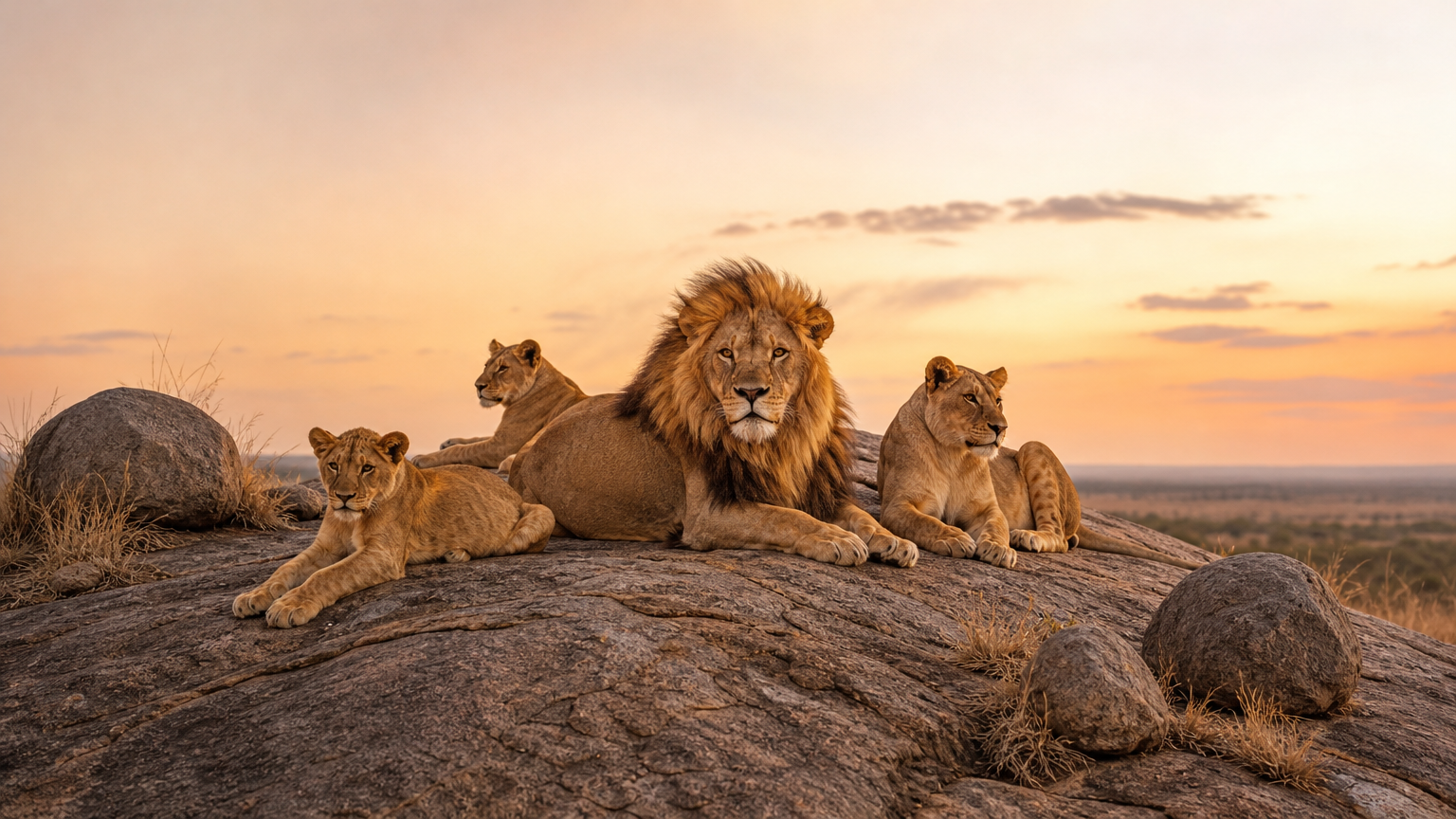
The landscape shapes what you see. Short-grass plains in the south feed the calving herds. Granite outcrops called kopjes, weathered boulder stacks, give lions and leopards lookout points and give you natural viewpoints. Rivers such as the Mara and the Grumeti cut through the north and west, and river crossings there are the scenes most travelers picture.
The Serengeti is not one wildlife show but several, and which one you see depends on where you stand and when you arrive.
Serengeti or Maasai Mara
You do not have to choose, because the two are one ecosystem divided by a border. The Maasai Mara is far smaller, and the herds are usually there from about July to October. The Serengeti has wildlife in every season because the herds are always somewhere in it. For a first safari focused on the migration, combining both gives you the longest window with the animals, which is why our Kenya and Tanzania itineraries link them.
When to go: where the herds are month by month
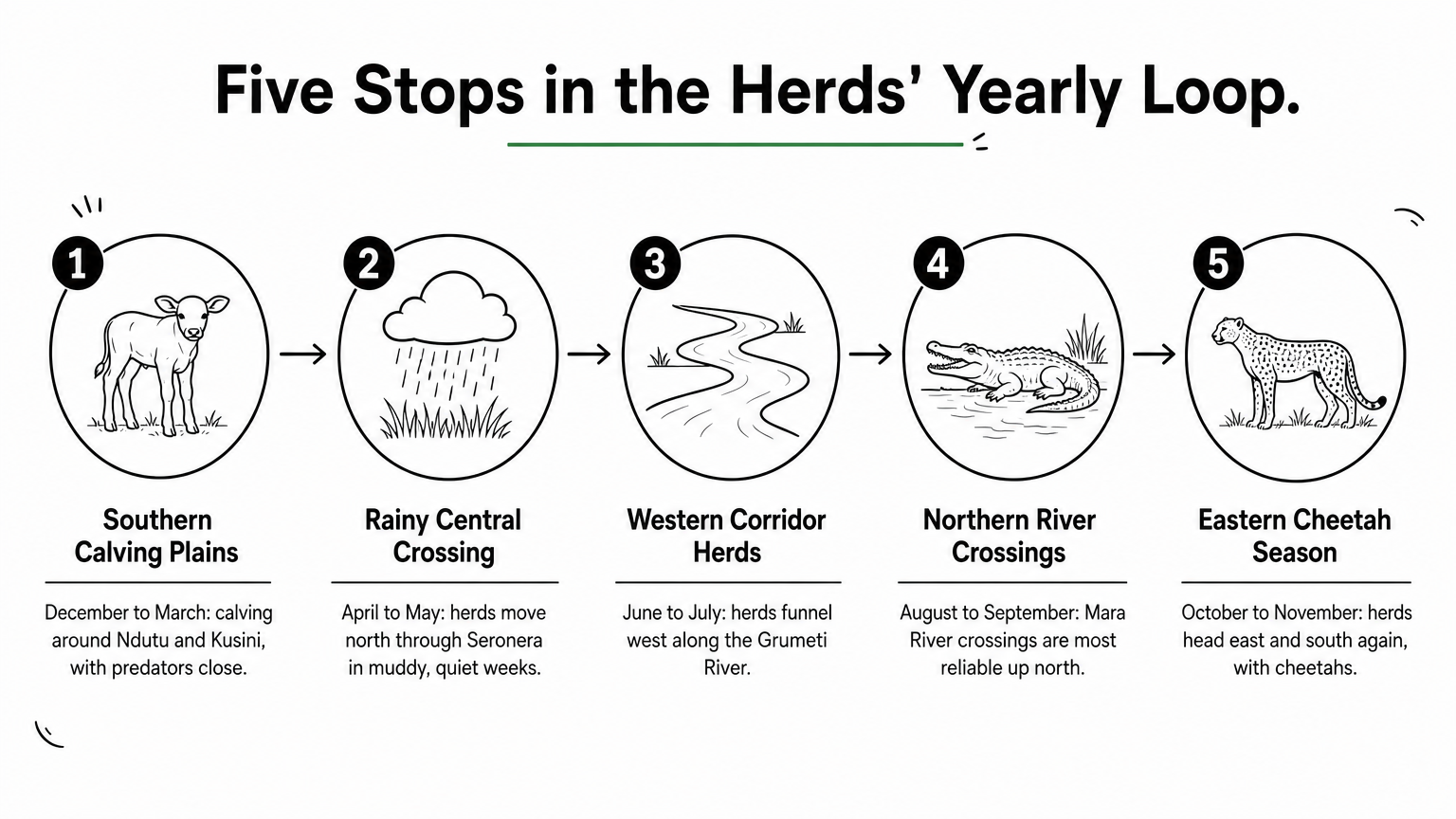
The best time for a Serengeti safari depends on what you want to see, because the herds move in a loop driven by rain. Calving and predators peak from January to March in the south, and the Mara River crossings peak in August and September in the north.
Where the herds are through the year
The pattern below holds in a normal year. Rains can shift movements by weeks, so treat the months as guidance, not a schedule.
| Period | Herd location | What you will see |
|---|---|---|
| December to March | Southern plains around Ndutu and Kusini | Calving, mainly around February, with cheetahs and other predators hunting newborns |
| April to May | Moving north through central Seronera | Rainy, muddy season with few visitors |
| June to July | Western Corridor along the Grumeti River | Herds funneling west, smaller river crossings |
| August to September | Northern Serengeti around Kogatende | Mara River crossings at their most reliable |
| October to November | Herds moving east and south again | Quieter north, cheetah sightings in the east |
Crossings are never on a timetable. Herds can mill at the bank for days and then cross in minutes. If a crossing is your priority, stay at least three nights in the north rather than gambling on one morning.
Dry season or green season
July to September is the busiest period. It is dry, and wildlife stays predictably close to the remaining water. Book your camps early for these months, because the best northern camps fill up well ahead.
The green season, roughly November to March, brings lush grass, newborn animals and excellent birdwatching. Most visitors avoid April and May, the rainiest and muddiest months, though lodges are quieter and rates are generally lower then. Our advice: choose August or September for river crossings, or February for calving and fewer vehicles.
Pick your month by the scene you want, because the herds are always somewhere in the Serengeti but never everywhere.
How to plan a Serengeti safari in Tanzania
To plan a Serengeti safari, choose your month, pick one or two regions of the park, allow at least three or four nights, and book lodging early. Everything else follows from those four decisions.
Getting there and getting around
Most travelers fly into Kilimanjaro International Airport and base themselves in Arusha, the safari hub. From there you either drive for a long day or take a light aircraft to one of the park's airstrips. The busiest airstrip is Seronera in the center. Others serve the north (Kogatende), the west (Grumeti) and the south (Kusini and Ndutu). Overland, the main entrance is Naabi Hill gate, with Ndabaka in the west and Klein's Gate in the northeast.
If you are visiting Kenya as well, you can link a Tanzania Serengeti safari to the Maasai Mara in one trip. Check visa and entry requirements for both countries well before you travel.
How many days and where to sleep
Plan three nights minimum for one region, and four or five nights if you want two, for example the central plains and the north. Lodges are solid brick or stone buildings. Camps use canvas and can be permanent, seasonal, or mobile and repositioned to follow the herds. Mobile camps put you closest to the action but have simpler facilities.
Game drives in a 4x4 with a pop-up roof are the core activity, usually at dawn and late afternoon. A sunrise hot-air balloon flight shows you the scale of the plains. The park has no official hiking trails, but some camps run guided bush walks with an armed ranger. Families benefit from camps with pools and short, flexible drives.
Before you go checklist
- Check that your passport is valid for the required period and that you hold the visas you need.
- Ask your doctor about malaria prevention, since the Serengeti is a malaria area.
- Buy travel insurance that covers medical evacuation.
- Pack neutral-colored clothing, a warm layer for dawn drives, binoculars and a hat.
- Follow park rules. Step out of the vehicle only when your guide says it is safe, and keep your distance at river crossings.
Spend more nights in fewer places, because the Serengeti rewards slow days over a long checklist.
What a Serengeti safari costs
A Serengeti safari costs a combination of park fees, lodging, transport and guiding, and the total swings widely by lodging tier and season. Park fees are the smallest piece, and your camp choice is the biggest.
Park fees you pay on top of lodging
Published rates for international visitors have been about $82.60 per adult for each 24 hours in peak season and $70.80 in low season. Non-East-African children aged 5 to 15 pay about $23.60 a day, and children under five enter free. Fees change, so confirm the current rates when you book.
For a worked example, take two adults and one 10-year-old for three 24-hour periods in peak season:
- Adults: 2 × $82.60 × 3 = $495.60
- Child: $23.60 × 3 = $70.80
- Total park fees: $566.40
Lodging, vehicle, guide and meals come on top, and your operator's quote should show them.
Packages that include the Serengeti
Our current Tanzania-inclusive private safaris show how length and style move the price. These are from-prices, and your quote depends on dates, group size and accommodation tier.
| Safari | Length | From price | Route highlights |
|---|---|---|---|
| 7-Day Epic Kenya & Tanzania Safari Experience | 7 days | $2,063 | Amboseli plus northern Tanzania circuit |
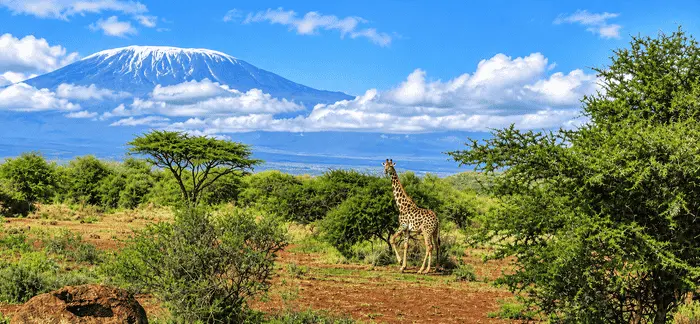
| 8-Day Magical Kenya & Tanzania Safari | 8 days | $2,711 | Kilimanjaro views, Ngorongoro Crater, Serengeti plains, Masai Mara |
| 9-Day Ultimate Kenya and Tanzania Safari Experience | 9 days | $3,429 | Great Migration, Ngorongoro, Serengeti, Masai Mara, Lake Nakuru |
| The Grand East African Luxury Safari | 10 days | $5,405 | Masai Mara, Serengeti, Ngorongoro Crater |
To see what drives the price, compare the 8-day and 10-day options. The extra two days and the luxury tier add roughly $2,700 to the from-price. Moving from a budget-friendly stay to a luxury camp has a bigger effect than adding a day.
Your lodging tier, not the park fee, decides what a Serengeti safari costs.
Planning your Serengeti trip
The Serengeti is a Tanzanian park of nearly 15,000 square kilometers where the Great Migration, big cats and open plains come together. Choose your month by the scene you want, stay at least three nights in each region, and budget for lodging first and park fees second. Combining it with the Maasai Mara gives you the longest time with the herds.
If you want a Serengeti itinerary built around your dates, pace and budget, request a tailored quote and itinerary from our team. You can also message us on WhatsApp, and we respond to enquiries within 24 hours.